
From Biochemistry Camp to Mentorship Legacy
- Virginia Journal of Medicine
- May 30, 2025
- 5 min read

Updated: Jul 19, 2025
A Q&A with Physician-Scientist Dr. Larry Borish, MD
Article written by Catherine Lyons
Ever wonder how a physician-scientist gets their start or what makes someone a great mentor? In this Q&A-style profile, we highlight the career of a physician-scientist who’s gone from high school research to mentoring future leaders in academic medicine. He shares his journey, lessons learned, and advice for anyone interested in research, mentorship, or staying inspired in medicine.
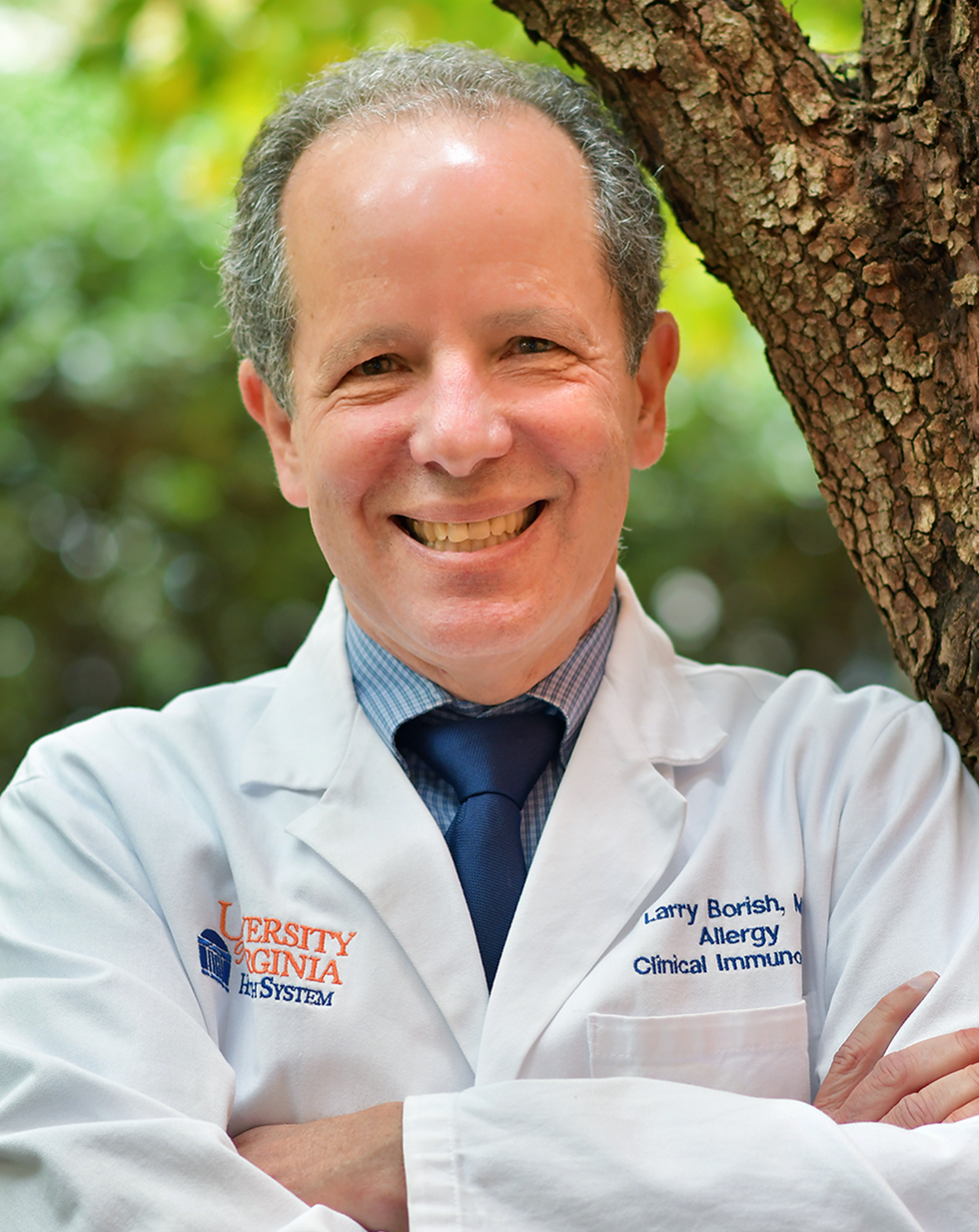
Allergist Larry Borish, MD, did his undergraduate work at Harvard College, where he received his B.A. (cum laude) in music in 1975. He received his M.D. from Boston University in 1979, after which he returned to Harvard for an internal medicine residency that was completed in 1982. Dr. Borish did his clinical training in allergy/immunology at the New England Medical Center, followed by several years of post-doctoral fellowship training in research in the laboratories of Dr. Ross Rocklin and Dr. Lanny Rosenwasser.
Dr. Borish was a faculty member at Tufts Medical School prior to his move to Colorado in 1989. From 1989 to 1999, he was an associate professor in medicine at the University of Colorado Health Sciences Center and a staff physician/principal investigator at the National Jewish Medical and Research Center. He is currently a Professor of Medicine at the University of Virginia and holds appointments in the Asthma and Allergic Diseases Center, Microbiology, and the Carter Immunology Center. He is an Associate Editor of the Annals of Allergy, Asthma, and Immunology. His NIH-funded research interests include the immune, cellular, and molecular mechanisms driving upper and lower airway allergic inflammation. In particular, his laboratory has been investigating molecular mechanisms driving respiratory virus-induced asthma pathogenesis and exacerbations. These studies focus on the role of innate immunity and the synergy of the failure of the innate immune system to restrict the viral infection with the tendency of the virus to promote a type 2/eosinophilic/allergic inflammatory response. His clinical interests include adult primary immune deficiencies, severe, exacerbation-prone asthma, and refractory chronic sinusitis/nasal polyposis.
He continues to play the oboe on rare occasions but is not prepared to give up his day job.
Q: How did he get his start in research?
Dr. Borish actually started doing research in high school. During the post-Sputnik push for American scientific advancement, the U.S. government funded specialized summer programs to train promising students. He was selected for one such program in biochemistry, where he studied calcium transport across mitochondrial membranes.
He jokes, “My kids are always very proud to know that when I was in high school, I went to biochemistry camp.”
And yes, it was just as nerdy and awesome as it sounds. That research earned him recognition in the Westinghouse Science Talent Search (now the Regeneron Science Talent Search).
He recalls being taken to dinner at the Watergate Hotel just a week before the break-in, saying, “That was my first experience with research… and dinner at the Watergate while Nixon was president.”
Q: What is he most proud of in his career?
His proudest achievements aren’t papers or awards-they’re his mentees. Over the years, he’s mentored more than 30 students and trainees, many of whom are now successful faculty members and independent researchers.
He highlighted two in particular: his first mentee to receive an RO1 grant and another who returned to UVA after training to join the faculty. He describes mentoring as incredibly fulfilling, though often unrecognized.
“Good mentoring is the most important thing a young faculty person needs and unfortunately, it’s a lot of work,” he said. “Nobody gives you RVUs for mentoring. You get a plaque. Great. I can’t bring that to a pawn shop and use it to help pay my salary.”
Even though there isn't great compensation for research, Dr. Borish believes that it is not difficult for students to find meaningful mentorship experiences.
“If you don’t like teaching, you won't be [at an academic institution],” he said.
Q: How does he approach mentoring students and trainees?
He believes mentorship starts with helping students learn how to ask the right questions. Many students jump into experiments without a clear hypothesis, which can derail an entire project (or grant application).
He’s adamant about teaching hypothesis development: “Your hypothesis is not your child. You have to be willing to kill it.”
He adds that science is about trying to disprove your hypothesis, not proving it.
One of the most valuable experiences of his own career was serving on NIH grant review committees because it taught him how to write better grants that focus on hypotheses and aims primarily. He tries to communicate these lessons he learned from his time reviewing grants to students.
When reviewing grants, it is easy to identify which grants he will recommend for funding because “[he is] 90% of [his] way to a decision after reading the hypothesis and specific aims. If [he] wasn’t excited by the first page, nothing in the next 12 was going to change that.”
Q: What skills do students need to succeed in academic medicine?
Two things: stay current, and communicate clearly.
As an allergist-immunologist, he emphasizes how quickly the field evolves.
“This year’s mouse biology is next year’s human drug.”
He points to the explosion of monoclonal antibodies and targeted biologics- therapies that require deep understanding of immunology to use well.
He also stressed the importance of communication, especially for writing grants, teaching, and collaborating. Being right isn’t enough if no one understands (or funds) your work.
Q: What excites him most about the future of his field?
He’s passionate about the potential for disease modification-not just treating symptoms, but actually preventing or curing chronic illnesses like asthma, allergies, and autoimmune diseases.
He’s notes that current biologics are effective but temporary: “They fix everybody, cure nobody, and cost a lot. That’s the pharmaceutical company’s fantasy drug.”
He sees promise in early-life immune education and research into environmental and epigenetic triggers.
“Our genes haven’t changed. But something in our environment has.”
He’s also a strong supporter of the hygiene hypothesis-with nuance.
“Broadly speaking, we’re doing this to ourselves. Sterile environments, overuse of antibiotics-they’re changing how the immune system develops.”
Dr. Borish reminds us that a career in medicine isn’t just about knowledge or credentials-it’s about curiosity, teaching, and making space for the next generation. Whether he’s laughing about chemistry camp or passionately defending the importance of mentorship, he offers a roadmap for students who want to make a lasting impact in academic medicine.
Interested in reading more from Dr. Borish? Check out some of his recent research works!
Teague WG, Griffiths CD, Boyd K,....Borish L. A novel syndrome of silent rhinovirus-associated bronchoalveolitis in children with recurrent wheeze. J Allergy Clin Immunol. 2024;154(3):571-579.e6. doi:10.1016/j.jaci.2024.04.027
Borish L. What's in a Clade? Clinical Impact of Rhinovirus Serotype on the Development and Severity of Asthma Exacerbations. J Allergy Clin Immunol Pract. 2025;13(1):105-106. doi:10.1016/j.jaip.2024.10.022
Harris D, Borish L. How we treat type 2 low asthma. Ann Allergy Asthma Immunol. 2024;133(1):43-46. doi:10.1016/j.anai.2024.04.013
Noonan E, Suozzi N, Smith AD, Lyons CE, Borish L, et al. Concurrence of Eosinophilic Esophagitis and Dyshidrotic Eczema. Dermatitis. 2024;35(4):404-406. doi:10.1089/derm.2023.0177
Zulfiqar MF, Revell R, Borish L. Dupilumab treatment in patients with hypereosinophilia: Real-world outcomes. Ann Allergy Asthma Immunol. Published online April 19, 2025. doi:10.1016/j.anai.2025.04.006


